Blog Flipping: The Ultimate Guide to Buying, Growing & Selling Blogs (2026)
A blog can be a great way to share your passions and connect with like-minded people. But did you know that you can also make money from selling your blog?
It’s true! Blog flipping is a process whereby you purchase an existing blog or create a new one, grow it for a while, and then sell it for a profit. It can also become a strong additional income stream or even a full-time business.
Before you jump in and start flipping blogs, it’s important to understand what blog flipping is and how to do it properly. If you’re completely new, I highly recommend starting with a simple breakdown of what blog flipping actually is before diving into the full strategy.
Blog flipping is the process of buying or building a blog, growing its traffic and revenue, and selling it for profit.
This guide is for you if you’re thinking about giving blog flipping a try. I’ll cover everything you need to know about how to buy and sell blogs, including:
- What is blog flipping?
- The benefits of blog flipping & its downside
- How to start a blog from scratch
- How to maximize your profits and sell your blog
- The process of selling your blog
- How to find and value potential blogs to flip
If you want to follow the exact system I use when building and selling sites, you can go through my complete blog flipping blueprint, where I break everything down step by step.
Ready to get started? Let’s dive in!

What is Blog Flipping?
Just like in the real world with real estate flipping, blog flipping is the process of buying and selling a blog or several blogs for a profit. You can either purchase an established blog or build a new one from scratch and then grow it until it is worth more than you paid for it. By selling or reselling those blogs, you can make a profit and build your portfolio of flipped blogs.
Blog flipping can be a great way to generate additional income, as long as you understand the process and do it properly.
If you want a more beginner-friendly explanation with examples, check out my full guide on what blog flipping is.
The Benefits of Blog Flipping
A few key benefits make blog flipping an attractive option for many people. First and foremost, it can be a very profitable side hustle. In fact, I’ve documented exactly how this plays out in real life, where I generated over $51K across more than 200 sales — and that’s just from one platform alone.
I used to own a blogging blog making an average monthly income of $100 – $150. In less than a year, I sold it for $4,500, which was 45x its monthly revenue, and that’s not an extreme case at all.
Many bloggers sold their websites for six-figure profits or even more. I’ve personally seen returns as high as 8x on a single flip, which I break down in detail in one of my case studies.
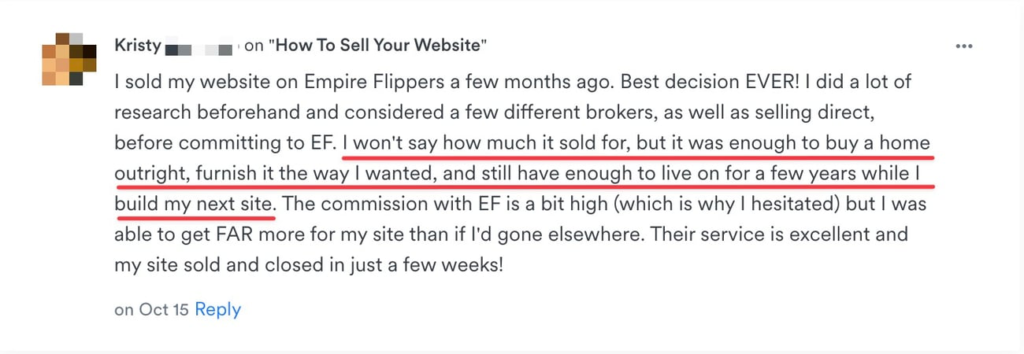
Another critical benefit of blog flipping is that it can be a relatively low-risk endeavor. Unlike other online businesses, you don’t need to invest much money upfront in starting. Nor do you need to put in years of hard work before seeing any return on your investment.
Of course, risks are always involved in any business venture, but if you do your due diligence and choose a solid blog to sell or buy, the risks are relatively low. In the worst case, at least you still own a blog. You can work on it later and turn it into a money-making online business.
Finally, blog flipping can be a relatively quick way to make money. If you have a successful flip, you can make your money back quickly and move on to the next project. This can be a great way to generate some quick cash if you want to start entrepreneurship but don’t necessarily want to commit to a long-term business venture.
The Downside of Blog Flipping
Now that we’ve covered the key benefits of blog flipping, let’s look at the downside. First and foremost, it’s important to note that selling blogs is not a get-rich-quick scheme. This is not your endeavor if you’re looking for a quick and easy way to make money.
Like any business, blog flipping requires time, effort, and consistency. It’s not something you can do half-heartedly and expect to see success. You need to be prepared to put in the work if you want to sell your blog and see a return on your investment.
Another critical downside of blog flipping is that it’s not a guaranteed money-maker. There’s always the potential that you could lose money on a flip. This is why it’s important to do your research and choose a solid blog to invest in. If you’re not careful, you could buy a dud that doesn’t make any money.
And last but not least, blog flipping can be a bit of a gamble. You never know for sure how much a blog is going to sell for. Even if you do your research and choose a quality blog, there’s always the potential that it could sell for less than you expect.
How to Create a Blog from Scratch
Starting a blog from scratch is one way to approach blog flipping, especially if you want full control over the asset from day one. However, this is just one part of the overall flipping process.
If your goal is to flip blogs for profit, I recommend following the exact process I use to flip blogs instead of treating this as an isolated task.
1. Choose a niche
Pick a focused niche that has clear monetization potential and audience demand.
2. Set up your site
Register a domain, choose hosting, and install WordPress.
3. Build the foundation
Use a clean theme, essential plugins, and basic branding.
4. Prepare for growth
Set up analytics, social profiles, and a content plan.
If you want the exact process I follow to build, grow, and flip blogs profitably, you can follow my full blog flipping process.
How to Maximize Your Profits and Sell Your Blog
Once you understand the basics, the real difference comes down to how you approach blog flipping as a business rather than just a one-off project.
If you’re serious about building a scalable system around this, I highly recommend reading my guide on how to start a blog flipping business. This is where most beginners get stuck — they focus on tactics instead of building a system.
Now, as you have gone through all the steps it takes to start a blog, let’s talk about how to make it worth the money you’re asking for.
1. Develop a strong content strategy
If you want to create a blog that is worth money, develop a content strategy focused on building topical authority and consistent publishing.
2. Write valuable content
Having a strong content strategy in place will help a lot when it comes to content creation, especially if you want to outsource the task. Having clear instructions and a guide to follow will make it easier for the writer(s) to produce quality content for your site.
The key to a successful blog is to write high-quality content relevant to your topic and your readers. You want to make sure your content is well-written, informative, and engaging.
If you’re not a great writer, you can always hire a content agency or a freelance writer from Upwork, Fiverr, etc., to help you with your content.
3. Optimize your blog for search engine
Search engine optimization (SEO) is one of the most important aspects of running a blog. It helps you rank higher in search results and get more organic traffic to your site.
Focus on targeting low-competition keywords with clear search intent.
3. Promote your blog
Once you have around 15 – 20 blog posts published, start promoting your website. One of the best ways to promote your blog is to guest post on other blogs in your niche. This will help you get exposure to a new audience and build links back to your website.
Another great way to promote your blog is to participate in online and offline communities related to your topic.
Pinterest is a robust platform that can help you drive traffic to your blog. If you’re blogging in a visual niche like fashion, beauty, or food, then you need to be on Pinterest.
4. Build an email list
Building an email list of interested readers is also a great way to make your blog valuable, as it will generate more traffic and potential sales for the new owner.
5. Monetize your blog
Monetization is what makes your blog valuable. The most common methods include display ads, affiliate marketing, sponsored content, and selling your own products.
The key is to build diversified and stable income streams that demonstrate long-term potential to buyers.
The Process of Selling a Blog
This is a simplified overview of the selling process — each step can be optimized further depending on your strategy and goals.
This is where most of the profit is actually realized — and it’s a critical part of the flipping process. If you want to see how this plays out in a real flip from start to finish, I break it down step-by-step here.
The process of selling a blog is relatively simple. It involves listing your blog on the marketplace, finding a buyer for your blog, transferring ownership of your blog, and then getting paid. However, there are a few things you need to do before you can start to list your blog.
1. Get your blog ready to sell
If you want to sell your blog for top dollar, you need to make sure it has traffic and income. SEO-optimized articles, a strong social media presence, and an email list are all things you can do to increase and keep the traffic to your blog until it sells.
You also need to make sure your blog has a strong foundation. This means it should be built on WordPress, have a professional theme, and be optimized for SEO.
Make sure your blog has clear monetization in place (ads, affiliate income, or products) so buyers can see its profit potential.
2. List & find a buyer for your blog
The next step is to find a buyer for your blog. You can do this through brokerages or by listing your blog for sale on online marketplaces like Flippa and Empire Flippers, or you can even create your own website marketplace to sell your blogs.
The most important thing is to ensure you find a reputable buyer willing to pay you what your site is worth.
In many cases, working with a broker can help you reach more buyers and secure a better deal.
3. Transfer the ownership of your blog
So you’ve found a buyer for your blog and you’ve agreed on a price. Sold! Congratulation! Big time! The next step is to transfer the ownership of your blog to the buyer.
This process is usually handled through your hosting account or migration tools, and the buyer takes full control once completed.
4. Get paid
Before transferring ownership, agree on a secure payment method (such as Escrow or wire transfer) and ensure full payment is received.
And that’s it! You’ve successfully sold a blog!
If you want to see how this process works in practice, including real numbers and timelines, check out my case studies:
How to Find & Value Potential Blogs to Flip
Finding the right blog is one of the most important parts of flipping — and it’s something you get better at with experience. I’ve shared a lot of the lessons I’ve learned after flipping 200+ blogs, including what to look for and what to avoid.
Now that we’ve covered the basics of blog flipping, how to start a new blog, and the process of selling a blog, it’s time to get into the nitty-gritty and start looking at some potential blogs to buy.
The first step to flip blogs is to develop a list of criteria your potential websites must meet. This will help you narrow down the field, focus on sites that are more likely to be successful, and value your potential purchases correctly. Here are a few key criteria that you should look for in a potential blog to flip:
1. It should make money
Or at least, if the blog is not making money yet, it should be in a profitable niche. This is probably the most essential criterion on the list. If you’re going to buy a blog, then it needs to be one that can generate revenue.
2. It should have a loyal audience
The more engaged an audience is with the blog, the higher the conversion rate will be and the easier it will be to monetize. Look for blogs that have been around for at least one year and have a sizable following on social media or email subscriptions. This can help you gauge how engaged the blog’s audience is.
3. It should have a good domain name
A good domain name is important for two reasons. First, it can help the blog rank higher in search engines. Second, it can make the blog more attractive to people who are interested in buying it. If you’re looking for a quality blog to flip, make sure it has a good domain name.
The .com extension is of course the most desirable, but .net and .co domains can also be good. Avoid domains with dashes or numbers or domains with personal names in them. These domains are less attractive and can make it harder to sell the blog.
4. The blog should have quality content
Needless to say, you also want to ensure the blog has quality content. This is important for two reasons. First, it will help the blog rank higher in search engines. Second, it will make the blog more attractive to potential buyers.
Look for well-written, informative, and SEO-optimized content.
5. The blog should have a clean and professional design
The design of the blog is also essential. A clean, professional, and well-designed blog will make it more attractive to buyers. A blog with a poor design will be harder to sell since it won’t look as professional.
The blog should have a clean, professional, and mobile-friendly design.
6. It should have a healthy mix of organic and paid traffic
If you’re into sites that already have traffic and income, you’ll want to ensure that the website has a healthy mix of organic and paid traffic.
A balanced traffic mix reduces risk and increases buyer confidence. If a blog relies too heavily on one traffic source, for example, Instagram traffic, it could risk losing traffic if that source dries up.
7. It should have a reasonable price tag
When flipping blogs, you want to ensure you’re not overpaying for the blog you’re buying. You also don’t want to undersell the blog you’re selling. Compare with similar recent sales to estimate a fair market value.
You can also use a website like Flippa to find comparable blog sales data. This will help you find a reasonable price for the blog you’re buying or selling.
8. The blog should have future growth potential
You also want to make sure the blog has future growth potential. This is important because it will help you sell the blog for a higher price in the future or buy the blog for a lower price today.
To evaluate a blog’s future growth potential, you’ll want to look at its niche and see if any trends are happening that could impact the blog’s growth. For example, if the niche is snowballing, the blog has a good chance of growing.
9. The blog should have a monetization strategy in place
Lastly, you want to ensure the blog has a monetization strategy. At the end of the day, it’s your new online business, and you want it to be profitable.
Look for diversified and sustainable revenue streams rather than relying on a single income source.
Once you’ve evaluated these nine aspects of a blog, you can make an educated decision as to whether or not it’s the right one for you.
The Bottom Line
You’ve just learned a lot about blog flipping and how to sell a blog. It takes work — but done right, it can become a highly profitable business. If you do it right, then you can easily make a full-time income from selling blogs.
So if you’re ready to go deeper, here’s where to go next:
- Start with the fundamentals: what blog flipping is
- Learn the exact execution process: step-by-step guide to flipping a blog
- Build a scalable system: how to start a blog flipping business
- See real results: how I made $51K flipping starter sites and how I achieved an 8x return on a single blog flip
That’s the exact path I’d follow if I were starting again today.
I hope this blog post has been helpful and informative. If you have any questions, then please feel free to leave a comment below and I’ll be happy to answer them!
12 Comments